Start with 13 cards and one simple idea.
You are dealt 13 cards. The remaining cards become a closed deck, and one card is turned up to start the open pile. The aim is to arrange all 13 cards into valid groups, with at least one pure sequence that does not use a joker.
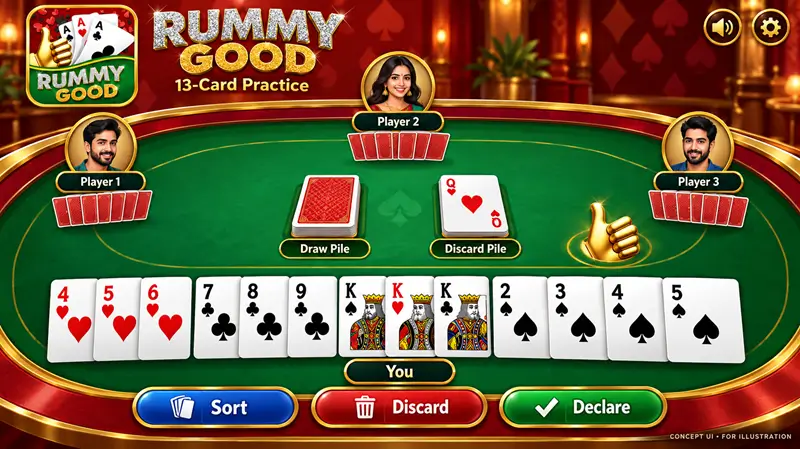
Sort your hand.
Group cards by suit, then look for ranks that sit next to each other. A tidy hand makes a run easier to see than a pile sorted by colour alone.
Look for a pure sequence.
A pure sequence is three or more cards of the same suit in order, such as 4♥ 5♥ 6♥. No joker is allowed in this group. Most 13-card tables expect at least one before a declaration counts.
Draw, then discard.
On your turn, take one card from the closed deck or the open pile. Then discard one card onto the open pile. You finish the turn with 13 cards again.
Complete the remaining groups.
After the pure sequence, the other cards should form sequences or sets. A set is three or four cards of the same rank in different suits, such as 8♥ 8♠ 8♦.
Check before declaring.
A declaration says the hand is finished. Count the cards, confirm one pure sequence, and make sure every card belongs to a valid group. An early declaration usually scores as a full penalty.
Try the three building blocks.
Same suit. In the right order.
This is a pure sequence. The suit never changes and the ranks step forward by one.
Same rank. Different suits.
This is a set. The cards match by rank, not by order, so it cannot replace a pure sequence.
A joker fills one gap.
Used as 5♣, the joker makes an impure sequence. Keep a separate pure sequence elsewhere in the hand.
A complete example hand
Thirteen cards can finish as four groups. One possible shape is a four-card pure sequence, a second sequence, and two sets.
- Sequence one, 4 cards: 4♥ 5♥ 6♥ 7♥
- Sequence two, 3 cards: 9♣ 10♣ J♣
- Set one, 3 cards: 8♠ 8♥ 8♦
- Set two, 3 cards: K♠ K♥ K♣
Printed jokers, two decks, and the exact penalty for a wrong declaration vary between rule books. This page teaches the widely used 13-card pattern. It does not claim that a Rummy Good app offers a particular mode.