These notes describe formats players commonly meet. They are not a promise that a Rummy Good app includes them.
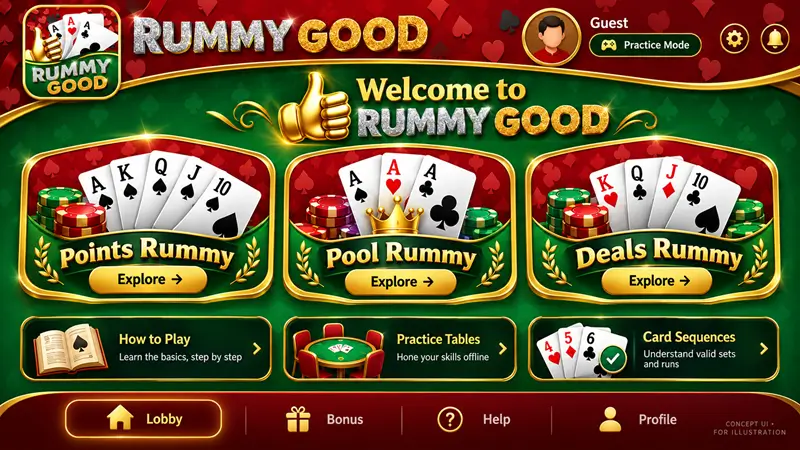
01 / Points Rummy
Each deal stands on its own. Someone declares, the hand is checked, and unfinished cards are valued. A valid declaration ends that deal. A wrong one usually gives the declarer the maximum penalty for the hand.
Learn this format first if you want the shortest loop: draw, discard, arrange, declare.
02 / Pool Rummy
Pool keeps a running score across deals. Players who cross a published limit, often talked about as 101 or 201, leave the table. The idea is endurance: one expensive hand matters more because it stays on the sheet.
03 / Deals Rummy
Deals fixes the length of the match, such as two or three deals. Everyone plays the agreed number, then the scores are compared. There is no elimination in the middle, so a poor opening deal can still be answered.
Which should you learn first?
| Format | What changes | What stays the same |
|---|---|---|
| Points | One deal, then a fresh start. | 13 cards, a pure sequence, valid groups. |
| Pool | A score that carries, and a limit that can eliminate you. | The same melds and the same need to check a declaration. |
| Deals | A fixed number of deals before anyone is compared. | Draw, discard, and the pure-sequence requirement. |
Nothing on this page is an entry fee, a prize, or a product feature. If you open an app, read that app’s own rules. They can differ from this guide.